
As we venture out, we’ll follow strict guidelines to ensure these incredible creatures are protected and respected. Let’s remember, these are wild animals – we can’t control their movements, so no guarantees on sightings! But one thing’s for sure, we’ll have a stunning coastline to enjoy.
“Let’s prepare you for your ocean adventure! What to expect and what we’re looking for: Embark on a thrilling journey into the Indian Ocean, where the waters teem with marine life! Keep your eyes peeled for majestic whales breaching the surface, and be the first to shout, “I see one!”
All about whales
Humpback Whale
Megaptera novaeangliae AKA “Big winged New Englander”
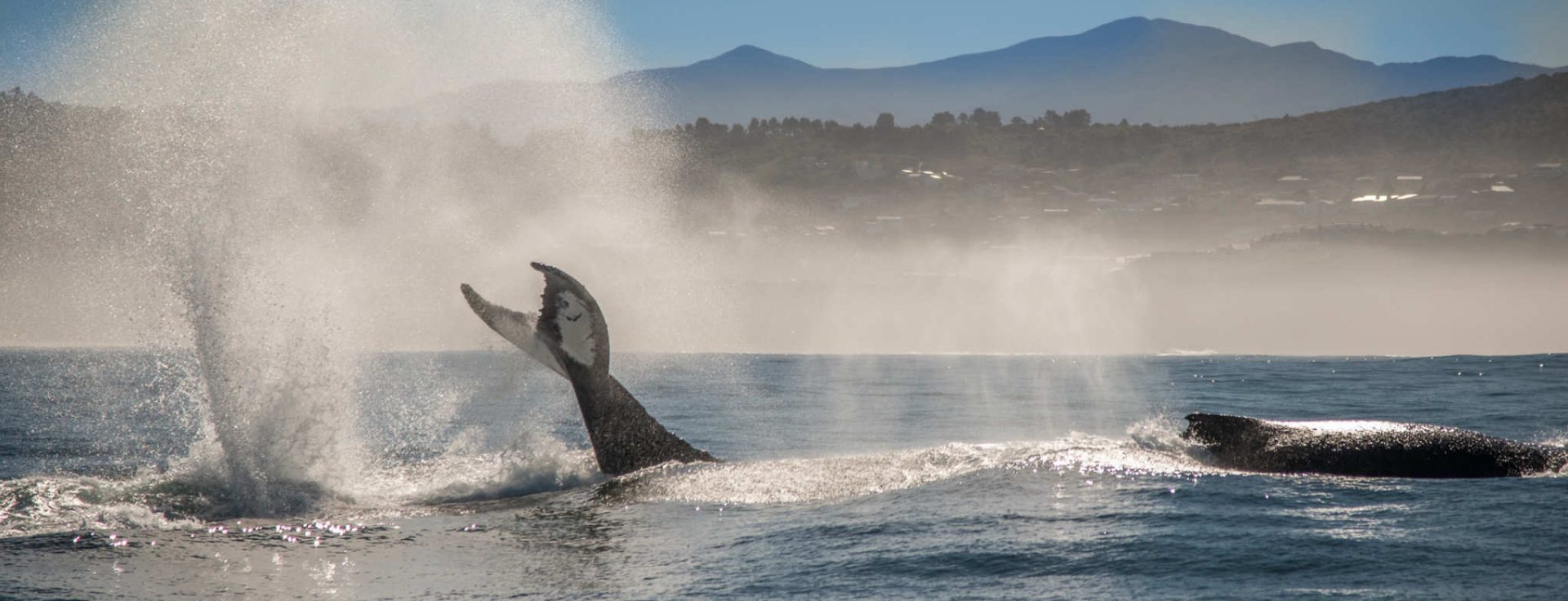
Humpback whales are the rockstars of the ocean! They’re social, playful, and known for their epic breaching displays. Their haunting songs are the most complex in the animal kingdom, and scientists are still trying to decipher their underwater language. These baleen whales are easily recognizable by their long pectoral fins (up to 4.6m!) and unique fluked tails. They’re migratory masters, traveling vast distances each year, and can be spotted along our coastline during winter and spring. Unfortunately, they’re also vulnerable, so let’s do our part to protect them!
Appearance – Dark grey with white underside, a low dorsal fin with wide base and a noticeable hump in front of the dorsal fin
Length – Up to 16m, with females being larger than males. Newborn calves are about 4.5m.
Weight – Adults – 25 – 45 tons. Newborns – 1 ton.
Blow – Two blowholes that create a tall, single plume measuring around 4 meters high.
Lifespan – 45-50 Years
Diet – Krill, and small fish such as mackerel and sardines
Sightings – (Migratory – June to November) During season they are sighted on 90-95% of our trips

Southern Right Whale
Eubalaena australis
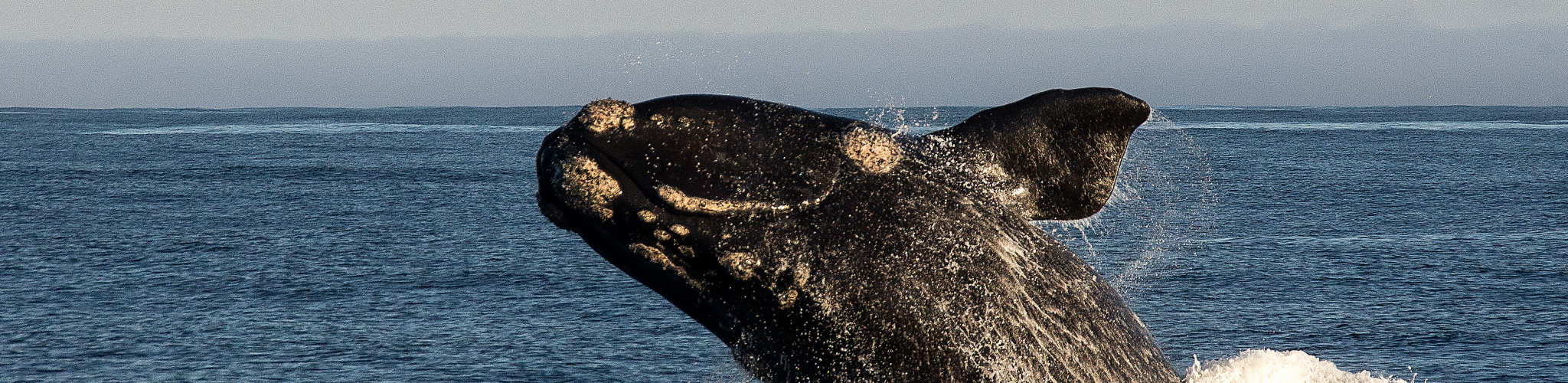
Southern African bays, like the protected area between Buffalo Bay and Brenton on Sea, are a hotspot for whales! During winter, mothers nurse their newborns close to shore, and mating groups put on a show with breaching and more! Southern Right whales are easy to spot, with callosities on their head, a broad finless back, and an arching mouth. Their dark grey or black skin is a striking sight, and they’re often seen with white patches on their belly.
Appearance – Black colouration with callosities on the head, no dorsal fin
Length – Up to 18m, with females being larger than males. New born calves are about 4.5m.
Weight – Adults – Up to 60 tons. Newborns – 1 ton.
Blow – Two blowholes that create a distinctive V-shaped blow which can measure up to 4 meters high
Lifespan – 50-100 years
Diet – Tiny crustaceans like copepods, krill and pteropods
Sightings – (Migratory – May / June to October / November) During season they are sighted on 75% of our trips
Other whales that we see are Bryde’s Whale: All year resident sighted on 60-70% of our trips and the Killer Whale (Orca)that has sporadic sightings.
All about Dolphins
The Indo-Pacific Bottlenose Dolphin
Tursiops aduncus
All year round we see the playful, smiling bottlenose dolphin, a highly intelligent marine mammal. Their streamlined bodies allow them to move swiftly through the water, and they can reach speeds of over 30 km an hour. They surface often to breathe, doing so two or three times a minute. Much like other dolphins, they are very playful and acrobatic, and we often see them leaping and dancing in the surf zone between Buffalo Bay and Brenton on Sea. Bottlenose dolphins travel in pods and communicate with each other by a complex system of squeaks and whistles.
Appearance – Overall grey coloration, ranging from a lighter belly to mid-grey flanks and a darker dorsal surface. Fairly long and prominent beak.
Length – Adults – Up to 2.4m in males, females slightly smaller. Newborn – Just over 1m
Weight – Adult – approximately 220kg. Newborn – approximately 20kg
Diet – Squid and pelagic fish
Sightings – Sighted all year round, seen on 80% of our trips
Pod Size – Varies from 5-15 animals, but at times over 100
The Long Beaked Common Dolphin
Delphinus capensis
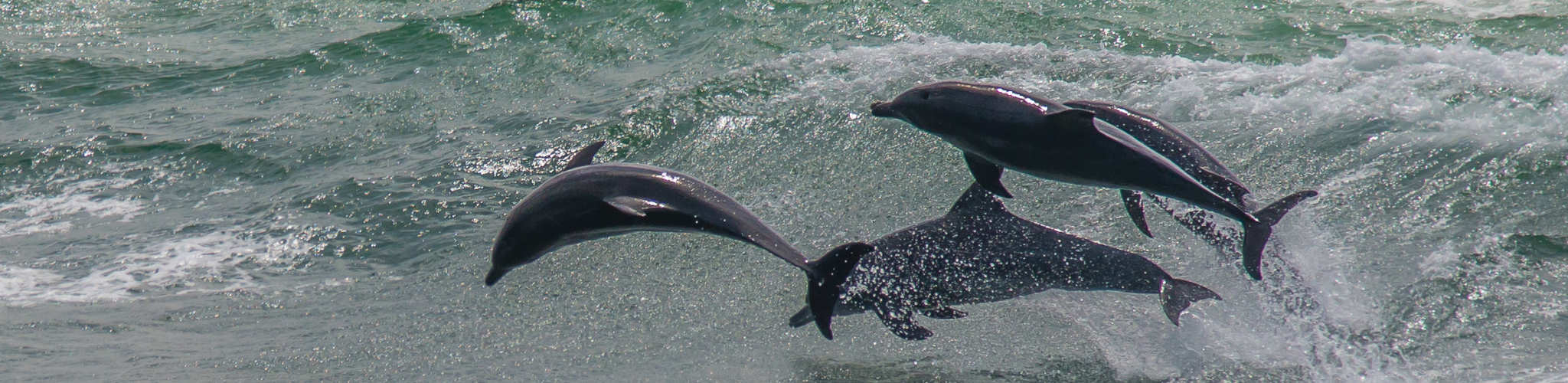
One of the most delightful marine mammals that we are fortunate enough to see on a regular basis in our local waters is the common dolphin of which there are two species within the genus: the short-beaked and the long-beaked common dolphin. They are very social and live in groups called pods. The number in a pod can be several hundred or many thousands, incredibly the largest numbering over 10,000 individuals. When large groups are seen, it is evidence of an abundance of bait fish in the area, and it is an exciting show stopping spectacle to see. What also makes them so appealing is that they are often seen taking part in sensational acrobatic behaviours, including somersaults, pitch poling, breaching and bow riding, moving with effortless grace through the water. They socially interact with one another using touch, echolocation and various forms of vocalisation including whistling, whining, and clicking.
Appearance – Complex and variable coloration, the tan lateral “window” and a white blaze on the flank form an hourglass pattern with a dark upper mandible, flipper and eye stripe.
Length – Adult – Up to 2.5m in males, slightly smaller in females. Newborns – On average around 0.98m
Weight – Adult – approximately 130kg. Newborn – Unknown
Diet – Small schooling fish and squid
Sightings – Sighted all year round, but peak sightings between October and January during season they are sighted on 80% of our trips
Pod Size – On average from 10 to over 100 animals, but can form very large schools

The Indo-Pacific Humpback Dolphin
Sousa chinensis
We are very enamoured of the Indo-Pacific humpback dolphin, a member of the genus sousa and easily identified by the obvious humps and elongated dorsal fins found on their backs. We have regular sightings of them within Buffalo Bay and Brenton, and we consider this a real privilege because they are very rare. It is a shallow water species usually found congregating in very small groups, mostly around rocky reefs or sand gullies, rarely deeper than about 50 metres. Unfortunately, there is limited scientific data on this species of dolphin, but what is known is that their numbers are in decline. Their propensity for inshore areas makes them extremely susceptible to the negative influence of humans, including pollution, bad fishing practises and recreational activities. They have been listed as Vulnerable on South Africa’s Red Data list. It is estimated that there are only about 1000 left on our coastline.
Appearance – Identified by its small, curved dorsal fin set above a distinct hump, and has similar coloration to the Indo-Pacific Bottlenose dolphin
Length – Adult – Up to 2.6m in males, females slightly smaller. Newborns – Around 1m
Weight – Adult – Approximately 260kg in males. Newborns – Approximately 14kg
Diet – Small fish and squid living near ocean floor
Sightings – Sighted all year round, Seen on 85 % of our trips
Pod Size – Small groups of 1-10 animals

Other General Sightings
These Pelagic Birds are seen on many occasions during our boat based tours off the coast of Knysna: Cape Gannet, Gulls, African penguin, Cape cormorant, White breasted cormorant, Terns, White chin petrel, Wandering albatross, Yellow-nosed albatross, Sub-Antarctic skua, Cory shearwater.
We also see Cape Clawless Otters and Cape fur seals as well as a wide variety of fish including Sunfish, Hammerhead sharks and Great white sharks.